Xiaomi
Xiaomi Poco F8 Pro 5G 256GB ROM 12GB RAM Dual SIM GSM Unlocked - Blue
Xiaomi Poco F8 Pro 5G 256GB ROM 12GB RAM Dual SIM GSM Unlocked - Blue
SKU: SKU:X-POCO-F8PRO-5G-12-256-BL
Low stock: 2 left
 Ships Today from New York
Will this phone work with my carrier?
Choose your country and carrier to check before ordering.
Thank you. We received your IMEI verification request. Once verified and approved, MyWorldPhone will email you the actual IMEI so you can verify it directly with your carrier. Please allow 24–48 hours for processing on weekdays only. Weekend requests will be reviewed on the next business day.
Couldn't load pickup availability
📞 Need Help? Call Toll-Free: 1-844-CELLMAX
Free Premium Accessories Included — A $20 Value
Premium accessories included free with every phone purchase.




🛒 Recommended Accessories


-
MYWORLDPHONE CUSTOMER REVIEWS
4.8
OUT OF 5
⭐⭐⭐⭐⭐Based on reviews
Excellent
Why Buy from Us
-

25+ Years of Experience in Business
-

Same-Day Shipping from New York
-

100% Genuine Unlocked Devices
-

Huge Selection of Smartphones
-

Free Shipping


Flagship AI Gaming Smartphone
POCO F8 Pro 5G AI
Blue • 256GB Storage • 12GB RAM
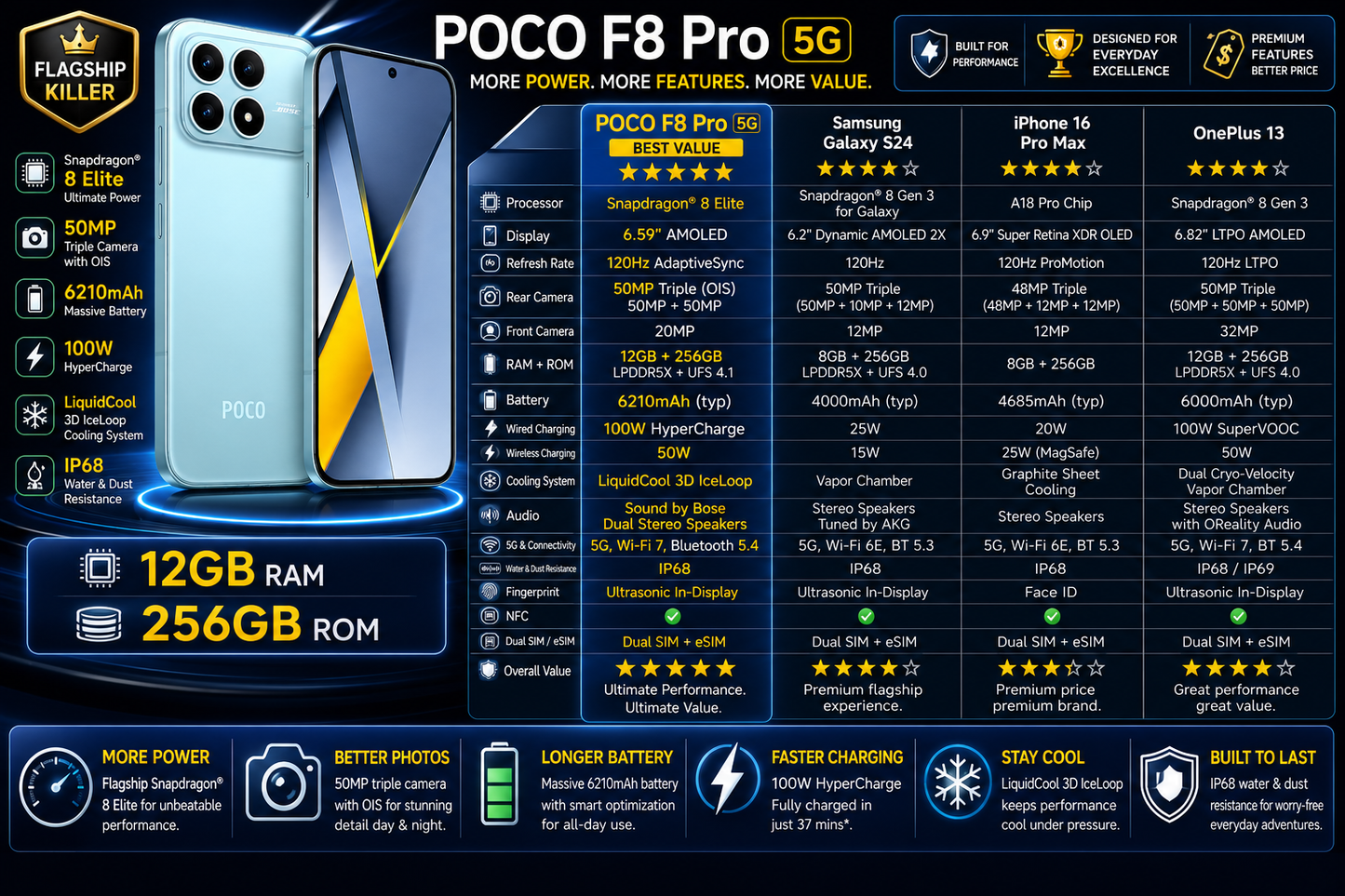
Experience flagship-level power, immersive entertainment, professional photography, and all-day battery life with the advanced POCO F8 Pro.
Snapdragon® 8 Elite Mobile Platform
Built on an advanced 3nm manufacturing process and powered by Qualcomm's Oryon CPU architecture, the Snapdragon® 8 Elite delivers outstanding speed, responsiveness, and energy efficiency for gaming, productivity, and multitasking.
WildBoost Gaming Optimization
WildBoost intelligently predicts workload demands and dynamically allocates CPU, GPU, and memory resources to maintain smoother gameplay, stable frame rates, and lower power consumption.
LiquidCool Technology 3D IceLoop
The advanced triple-layer IceLoop cooling system significantly improves thermal conductivity and expands the cooling area, helping the device maintain peak performance during long gaming sessions.
Massive 6210mAh Battery
Enjoy all-day power with a high-capacity battery engineered for gaming, entertainment, work, and everyday productivity without constant charging.
100W HyperCharge
Ultra-fast charging technology quickly restores battery life, keeping downtime to a minimum and getting you back into action faster.
Built For Long-Term Reliability
Engineered for durability, the battery retains over 80% of its original capacity even after approximately 1,600 charging cycles.
6.59" HyperRGB AMOLED Display
Experience vivid colors, deep contrast, smooth visuals, and immersive viewing on the stunning 120Hz AMOLED display with ultra-slim bezels.
50MP Triple Camera System
Capture detailed photos and videos with the advanced 50MP triple-camera setup featuring Optical Image Stabilization and a flagship 60mm telephoto lens for enhanced versatility.
Bose-Tuned Stereo Speakers
Enjoy rich, powerful, and immersive sound through symmetrical Bose-tuned stereo speakers designed for movies, gaming, music, and calls.
5G • NFC • Dual SIM
Stay connected with ultra-fast 5G speeds, NFC mobile payments, and Dual SIM flexibility for work, travel, and daily convenience.
Factory Unlocked Global Version
Compatible with T-Mobile, Mint Mobile, Tello, and supported GSM networks worldwide for maximum flexibility and convenience.
Key Specifications
Storage & Memory
256GB Storage
12GB RAM
Processor
Snapdragon® 8 Elite
Display
6.59" AMOLED
120Hz Refresh Rate
Battery
6210mAh Capacity
Charging
100W HyperCharge
Cooling
3D Triple-Layer IceLoop
Camera
50MP Triple Camera
OIS + Telephoto
Connectivity
5G • NFC • Dual SIM
| Network | Technology | GSM / HSPA / LTE / 5G |
|---|---|---|
| 2G bands | GSM 850 / 900 / 1800 / 1900 | |
| 3G bands | HSDPA 800 / 850 / 900 / 1700(AWS) / 1900 / 2100 | |
| 4G bands | 1, 2, 3, 4, 5, 7, 8, 18, 19, 20, 26, 28, 38, 40, 41, 42, 48, 66, 71 | |
| 5G bands | 1, 2, 3, 5, 7, 8, 20, 26, 28, 38, 40, 41, 48, 66, 71, 77, 78 SA/NSA | |
| Speed | HSPA, LTE, 5G |
| Launch | Announced | 2025, November 26 |
|---|---|---|
| Status | Available. Released 2025, November 26 |
| Body | Dimensions | 157.5 x 75.3 x 8 mm (6.20 x 2.96 x 0.31 in) |
|---|---|---|
| Weight | 199 g (7.02 oz) | |
| Build | Glass front (Gorilla Glass 7i), aluminum frame, glass back | |
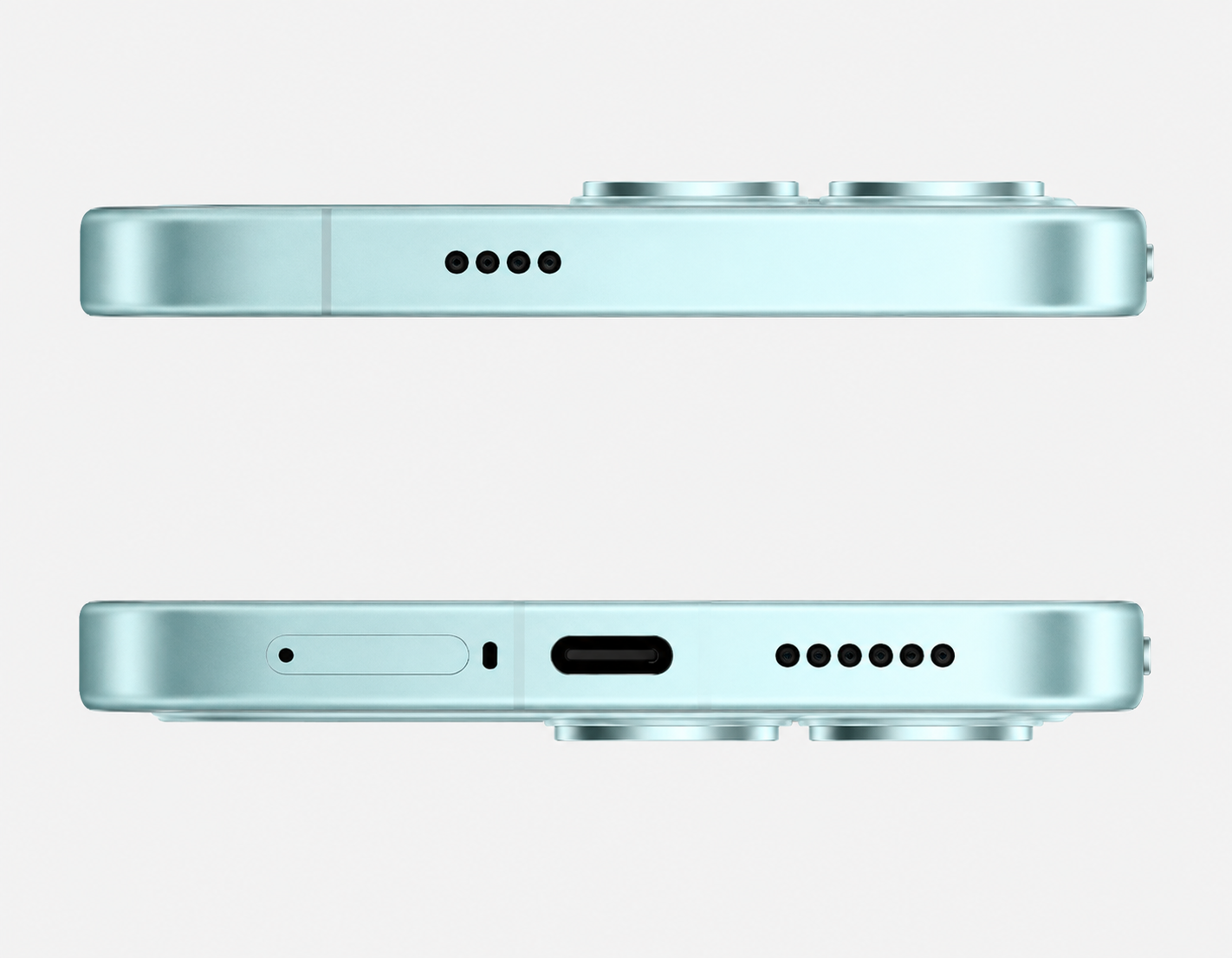
| SIM | · Nano-SIM + Nano-SIM + eSIM + eSIM (max 2 at a time) · Nano-SIM + Nano-SIM + eSIM (max 2 at a time) |
|
| IP68 dust tight and water resistant (immersible up to 1.5m for 30 min) |
| Display | Type | AMOLED, 68B colors, 2560Hz PWM, 120Hz, Dolby Vision, HDR10+, 2000 nits (HBM), 3500 nits (peak) |
|---|---|---|
| Size | 6.59 inches, 106.5 cm2 (~89.8% screen-to-body ratio) | |
| Resolution | 1156 x 2510 pixels, 19.5:9 ratio (~419 ppi density) | |
| Protection | Corning Gorilla Glass 7i |
| Platform | OS | Android 16, HyperOS 3 |
|---|---|---|
| Chipset | Qualcomm SM8750-AB Snapdragon 8 Elite (3 nm) | |
| CPU | Octa-core (2x4.32 GHz Oryon V2 Phoenix L + 6x3.53 GHz Oryon V2 Phoenix M) | |
| GPU | Adreno 830 |
| Memory | Card slot | No |
|---|---|---|
| Internal | 256GB 12GB RAM, 512GB 12GB RAM | |
| UFS 4.1 |
| Main Camera | Triple | 50 MP, f/1.9, 24mm (wide), 1/1.55", 1.0µm, multi-directional PDAF, OIS 50 MP, f/2.2, 60mm (telephoto), 1/2.88", 0.61µm, multi-directional PDAF, 2.5x optical zoom 8 MP, f/2.2, 15mm, 120˚ (ultrawide), 1/4.0", 1.12µm |
|---|---|---|
| Features | Color spectrum sensor, LED flash, HDR, panorama | |
| Video | 8K@30fps, 4K@30/60fps, 1080p@30/60/120/240/960fps, gyro-EIS, HDR10+ |
| Selfie camera | Single | 20 MP, f/2.2, 21mm (wide), 1/4.0", 0.7µm |
|---|---|---|
| Features | HDR | |
| Video | 1080p@30/60fps |
| Sound | Loudspeaker | Yes, with stereo speakers (with Dolby Atmos) |
|---|---|---|
| 3.5mm jack | No | |
| Tuned by Bose 24-bit/192kHz Hi-Res & Hi-Res wireless audio |
| Comms | WLAN | Wi-Fi 802.11 a/b/g/n/ac/6/7, dual-band, Wi-Fi Direct |
|---|---|---|
| Bluetooth | 5.4, A2DP, LE, aptX HD, aptX Adaptive, LHDC 5.0, ASHA, Auracast | |
| Positioning | GPS (L1+L5), BDS (B1I+B1c+B2a), GALILEO (E1+E5a), QZSS (L1+L5), NavIC (L5), GLONASS | |
| NFC | Yes | |
| Infrared port | Yes | |
| Radio | No | |
| USB | USB Type-C, OTG |
| Features | Sensors | Fingerprint (under display, ultrasonic), accelerometer, gyro, proximity, compass |
|---|
| Battery | Type | 6210 mAh |
|---|---|---|
| Charging | 100W wired, PD3.0, QC3+, 100W PPS, 100% in 37 min, 22.5W reverse wired |
| Misc | Colors | Titanium Silver, Blue, Black |
|---|---|---|
| Models | 2510DPC44G |
| Our Tests | Performance | AnTuTu: 2480773 (v10), 3023050 (v11) GeekBench: 8610 (v6) 3DMark: 6068 (Wild Life Extreme) |
|---|---|---|
| Display | 1094 nits max brightness (measured) | |
| Loudspeaker | -23.3 LUFS (Very good) | |
| Battery |
Active use score 17:35h
|
| Warranty | No Warranty |
|---|
| 1pcs | Xiaomi Poco F8 Ultra 5G |
| 1pcs | Battery. |
| 1pcs | Home Charger. |
| 1pcs | Headphone. |
| 1pcs | Data Cable. |
| 1pcs | User Manual. |
1. Is the POCO F8 Pro 5G factory unlocked?
Yes. This POCO F8 Pro is sold factory unlocked, meaning it is not permanently locked to a single wireless carrier. Actual carrier compatibility still depends on supported network bands, IMEI eligibility, VoLTE/IMS provisioning, eSIM support, carrier policies, service plan, and local coverage.
2. Which configuration is this listing for?
This listing is specifically for the POCO F8 Pro 5G with 12GB RAM and 256GB internal storage.
3. What color is this model?
This listing is for the official Blue color.
4. Is Blue an official POCO F8 Pro color?
Yes. POCO officially offers the F8 Pro in Blue, Black, and Titanium Silver.
5. Is the POCO F8 Pro a 5G smartphone?
Yes. It supports both 5G Standalone (SA) and 5G Non-Standalone (NSA) connectivity on compatible networks.
6. Does it support Dual SIM?
Yes. The POCO F8 Pro supports several Dual SIM configurations, including physical Nano-SIM and eSIM combinations.
7. Does the POCO F8 Pro support eSIM?
Yes. Supported configurations include:
- Nano-SIM + Nano-SIM
- Nano-SIM + eSIM
- eSIM + eSIM
A maximum of two SIM identities can be active at one time. eSIM availability depends on your carrier and region.
8. What operating system does the POCO F8 Pro use?
The first global software version is Xiaomi HyperOS 3 based on Android 16.
9. Is the POCO F8 Pro considered a flagship-level smartphone?
Yes. It combines Qualcomm's flagship Snapdragon 8 Elite processor with high-speed LPDDR5X RAM, UFS 4.1 storage, advanced cooling, a 120Hz AMOLED display, 100W charging, and premium camera and audio hardware.
10. What are the biggest highlights of the POCO F8 Pro?
Major features include:
- Snapdragon 8 Elite
- 12GB LPDDR5X RAM
- 256GB UFS 4.1 storage
- 6.59-inch 120Hz AMOLED display
- 50MP main camera with OIS
- 50MP telephoto camera
- 8MP ultrawide camera
- 20MP front camera
- 6210mAh battery
- 100W HyperCharge
- Wi-Fi 7
- Bluetooth 5.4
- eSIM
- NFC
- Sound by Bose
- IP68 protection
Snapdragon 8 Elite Processor
11. What processor powers the POCO F8 Pro?
The phone uses Qualcomm's flagship Snapdragon 8 Elite Mobile Platform.
12. What semiconductor process is used?
The Snapdragon 8 Elite is manufactured using an advanced 3nm semiconductor process.
13. Why does a 3nm processor matter?
A smaller semiconductor process can increase transistor density while improving performance per watt. This allows very high processing performance without increasing power consumption proportionally.
14. How many CPU cores does the Snapdragon 8 Elite have?
The POCO F8 Pro uses an octa-core CPU, meaning eight CPU cores.
15. How is the CPU configured?
The CPU uses:
- 2 Prime Oryon cores up to 4.32GHz
- 6 Performance Oryon cores up to 3.53GHz
16. What is Qualcomm Oryon?
Oryon is Qualcomm's high-performance CPU architecture designed to provide strong instructions-per-clock performance and improved efficiency compared with earlier Snapdragon CPU designs.
17. Does every CPU core run at 4.32GHz?
No. The two Prime cores can reach up to approximately 4.32GHz, while the remaining six Performance cores operate at lower maximum frequencies.
18. Is Snapdragon 8 Elite a 64-bit processor?
Yes. The Snapdragon 8 Elite uses a modern 64-bit architecture.
19. What GPU does the POCO F8 Pro use?
The phone uses the Qualcomm Adreno 830 GPU.
20. What does the GPU do?
The GPU handles computationally intensive graphical workloads such as:
- 3D gaming
- Interface animation
- Graphics rendering
- Visual effects
- Image processing
- Video effects
- Certain parallel-computing operations
Performance & Gaming
21. Is the POCO F8 Pro good for gaming?
Yes. Snapdragon 8 Elite, Adreno 830 graphics, 12GB LPDDR5X memory, UFS 4.1 storage, 120Hz AMOLED and advanced cooling make it well suited for demanding mobile gaming.
22. What is WildBoost Optimization 5.0?
WildBoost 5.0 is POCO's performance-management system designed to optimize processor, GPU, memory and power behavior during supported games.
23. Can supported games run at 120 FPS?
Yes. POCO's official technical information lists support for high-frame-rate operation up to approximately 120 FPS in certain supported games and configurations.
24. Does a 120Hz screen automatically make every game run at 120 FPS?
No. Refresh rate and rendered frame rate are different. The display can refresh up to 120 times per second, but the game must actually produce sufficient frames.
25. What is frame time?
Frame time is the amount of time required to produce each individual frame.
At:
- 30 FPS → approximately 33.3ms per frame
- 60 FPS → approximately 16.7ms
- 90 FPS → approximately 11.1ms
- 120 FPS → approximately 8.3ms
26. Why is stable frame time important?
A consistent 60 FPS can sometimes feel smoother than an unstable frame rate averaging much higher because irregular frame delivery produces visible stutter.
27. What is thermal throttling?
Thermal throttling is an automatic reduction in CPU or GPU frequency when internal temperatures rise beyond an optimal operating range.
28. Is thermal throttling a defect?
No. It is a normal safety and thermal-management mechanism used by modern high-performance processors.
29. Why can gaming make the phone warm?
Gaming can place heavy simultaneous workloads on the CPU, GPU, RAM, storage, wireless radios, battery and display. Electrical power consumed by these components ultimately becomes heat.
30. Can the POCO F8 Pro maintain maximum 4.32GHz speed continuously?
Not necessarily. Processor frequencies change dynamically according to workload, temperature, battery level and power limits.
AI & Hexagon Processing
31. Does the Snapdragon 8 Elite have dedicated AI hardware?
Yes. The POCO F8 Pro uses Qualcomm's Hexagon processing architecture for supported AI workloads.
32. What does an AI accelerator do?
Specialized AI hardware efficiently performs mathematical operations commonly used by neural networks, such as matrix multiplication and tensor calculations.
33. Why not perform all AI processing on the CPU?
General-purpose CPUs can execute AI workloads, but specialized neural-processing hardware can often complete supported calculations faster and with lower power consumption.
34. Does the POCO F8 Pro support AI Writing?
Yes. AI Writing is supported where the software feature is available.
35. Does it support AI Speech Recognition?
Yes. AI Speech Recognition is supported in compatible regions and software versions.
36. Does it support Circle to Search?
Yes. Circle to Search with Google is supported where available.
37. Does it support Google Gemini?
Yes. Gemini support is included, subject to Google service availability, account requirements and regional support.
38. Do all AI features work offline?
No. Some processing may happen locally, while other features require internet connectivity, cloud processing or supported online services.
Cooling Technology
39. What cooling system does the POCO F8 Pro use?
The phone uses a 3D Triple-layer IceLoop System.
40. What does the cooling system actually do?
It transfers thermal energy away from high-temperature components and distributes it across a larger internal area where it can dissipate more effectively.
41. Why is cooling important in a flagship processor?
Even energy-efficient processors generate significant heat under sustained workloads such as gaming, AI processing, video encoding and camera use.
42. Does better cooling increase the processor's maximum clock speed?
No. It does not change the processor's official maximum specification. Better cooling helps the device sustain higher performance for longer before thermal limits are reached.
RAM & Storage
43. How much RAM does this version have?
This model includes 12GB of LPDDR5X RAM.
44. What is LPDDR5X?
LPDDR5X is a high-speed, low-power memory standard developed for mobile devices.
45. How fast is the RAM?
POCO specifies data-transfer speeds of up to approximately 9600Mbps.
46. Why does RAM bandwidth matter?
The CPU, GPU and AI processors constantly exchange information with system memory. Higher bandwidth allows more data to move in a shorter amount of time.
47. Does the 12GB/256GB model support memory extension?
Yes. The 12GB + 256GB version can support additional virtual memory using part of the internal storage.
48. Is virtual RAM the same as physical LPDDR5X RAM?
No. Physical RAM is much faster. Virtual memory uses internal flash storage as supplementary memory and should not be considered equivalent to additional physical RAM.
49. How much internal storage does this version have?
This listing includes 256GB of internal storage.
50. What storage technology does it use?
The POCO F8 Pro uses UFS 4.1 storage.
51. What does UFS mean?
UFS stands for Universal Flash Storage.
52. Why is UFS 4.1 important?
Fast storage can improve:
- App launch times
- Game loading
- Large-file transfers
- Software installation
- Photo processing
- Video recording
- Overall system responsiveness
53. Is the full 256GB available to the customer?
No. Xiaomi HyperOS, Android, system partitions, recovery files and preinstalled applications consume some of the advertised capacity.
54. Does the POCO F8 Pro have a microSD card slot?
No. The POCO F8 Pro does not support microSD expandable storage.
AMOLED Display
55. How large is the display?
The POCO F8 Pro features a 6.59-inch AMOLED display.
56. What is the display resolution?
The resolution is 2510 × 1156 pixels.
57. What is the approximate pixel density?
The display has approximately 419 pixels per inch.
58. What is AMOLED?
AMOLED pixels create their own light individually rather than using a separate LCD backlight.
59. Why can AMOLED produce deep blacks?
Individual pixels displaying black can effectively switch off, producing extremely low black levels and high contrast.
60. What is the display contrast ratio?
POCO specifies an approximately 5,000,000:1 contrast ratio.
61. What is the maximum refresh rate?
The display supports refresh rates up to 120Hz.
62. What is the normal touch sampling rate?
The screen supports touch sampling up to approximately 480Hz.
63. What is the instantaneous touch sampling rate?
Under supported Game Turbo conditions, instantaneous touch sampling can reach approximately 2560Hz.
64. Is 2560Hz the screen refresh rate?
No. This is important:
120Hz = maximum display refresh rate
2560Hz = instantaneous touch sampling rate under supported Game Turbo conditions
They measure completely different functions.
65. Why does higher touch sampling matter?
The screen checks for finger input more frequently, which can reduce perceived touch latency during rapid gaming interactions.
Display Brightness, HDR & Color
66. How bright can the POCO F8 Pro display become?
POCO specifies approximately:
- 600 nits typical brightness
- Up to 2000 nits HBM/HDR brightness
- Up to 3500 nits local peak brightness
67. Does the whole screen continuously operate at 3500 nits?
No. Peak-brightness specifications apply under particular content and test conditions and usually involve only part of the display.
68. How many colors can the display reproduce?
The display supports 12-bit color depth, representing approximately 68 billion colors.
69. What is DCI-P3?
DCI-P3 is a wide color-gamut standard widely used in digital cinema and premium display devices.
70. Does the POCO F8 Pro support HDR10+?
Yes. HDR10+ playback is supported.
71. Does it support Dolby Vision?
Yes. The display supports Dolby Vision content.
72. What dimming system does the POCO F8 Pro officially use?
The display uses full DC dimming.
73. What is DC dimming?
DC dimming controls OLED brightness primarily by adjusting electrical power rather than relying on lower-frequency pulsed brightness control.
74. Does the POCO F8 Pro use “2560Hz PWM dimming”?
No. 2560Hz refers to instantaneous touch sampling, not PWM dimming. The official display specification identifies DC dimming.
75. What protects the screen?
The display uses Corning Gorilla Glass 7i.
Main Camera
76. What is the main rear-camera resolution?
The primary camera is 50MP.
77. What image sensor technology does the main camera use?
POCO identifies it as the Light Fusion 800 imaging system.
78. How large is the main camera sensor?
The official product specification lists an approximately 1/1.55-inch sensor.
79. What is the main-camera aperture?
The main camera uses approximately f/1.88.
80. Does the main camera have OIS?
Yes. The 50MP primary camera includes Optical Image Stabilization.
81. What does OIS do?
OIS physically compensates for small amounts of hand movement, helping reduce blur and improve stabilization.
82. Why is OIS particularly useful at night?
Dark scenes often require longer exposure times. Longer exposure increases the chance that hand movement will cause visible blur.
83. What does 2.0μm 4-in-1 Super Pixel mean?
The sensor can combine information from four neighboring physical pixels to create a larger effective output pixel of approximately 2.0μm.
84. What is pixel binning?
Pixel binning combines information from several sensor photosites into one output pixel. This can improve effective light capture and reduce noise in suitable conditions.
Telephoto & Ultrawide Cameras
85. Does the POCO F8 Pro have a real telephoto camera?
Yes. It includes a dedicated 50MP telephoto camera.
86. What is the telephoto focal length?
The telephoto camera uses an approximately 60mm-equivalent focal length.
87. What optical zoom does it provide?
The camera system provides approximately 2.5x optical zoom at the telephoto position.
88. Why is a 60mm-equivalent camera useful for portraits?
Moderate telephoto focal lengths can provide more flattering facial perspective and allow greater working distance than very wide smartphone lenses.
89. What is the telephoto-camera aperture?
The 50MP telephoto uses approximately f/2.2.
90. How far can digital photo zoom extend?
POCO specifies a photography zoom range extending from approximately 0.6x to 30x, with the principal optical positions at approximately 0.6x, 1x and 2.5x.
91. What is the ultrawide-camera resolution?
The POCO F8 Pro includes an 8MP ultrawide camera.
92. What is the ultrawide camera useful for?
It is useful for:
- Landscapes
- Architecture
- Large groups
- Interior photography
- Travel scenes
- Situations where you cannot physically move farther away
93. What are the correct individual pixel sizes for the telephoto and ultrawide cameras?
POCO's technical documentation lists approximately:
- Telephoto: 1.12μm
- Ultrawide: 0.612μm
These values should not be reversed.
Front Camera & Video
94. What is the front-camera resolution?
The POCO F8 Pro uses a 20MP front-facing camera.
95. What video resolutions can the rear cameras record?
Supported rear video modes include:
- 8K at 30fps
- 4K at 30fps
- 4K at 60fps
- 1080p at 30fps
- 1080p at 60fps
- Slow-motion modes at supported resolutions and frame rates
96. Can the front camera record 4K video?
No. The official specification lists front-camera recording up to 1080p at 30fps or 60fps.
97. What package contents should I expect?
Package contents can vary by country or regional version. POCO's official package information lists items such as:
- POCO F8 Pro
- USB Type-C cable
- SIM eject tool
- Protective case
- Quick Start Guide
- Warranty card
- Desiccant
- Safety information in applicable regions
- Power adapter in applicable regional packages
The exact package supplied with your order should be confirmed from the specific inventory being sold because regional packaging can differ.
Battery, Charging & Ports
98. What battery and charging technology does the POCO F8 Pro use?
The phone contains a 6210mAh typical-capacity dual-cell lithium-polymer battery.
Charging features include:
- 100W HyperCharge
- USB PD 2.0
- USB PD 3.0
- PPS
- QC 2.0
- QC 3.0
- QC 3+
- QC 4
- QC 4+
- Up to 22.5W wired reverse charging
Under POCO's controlled laboratory conditions, a full charge can take approximately 37 minutes when using appropriate compatible charging equipment and operating conditions.
The phone does not support wireless charging and does not support reverse wireless charging.
Its USB connection is:
USB Type-C / USB 2.0
It supports USB OTG, but does not support DisplayPort Alt Mode or wired video output.
Connectivity, Audio & Navigation
99. What advanced connectivity and audio features does the POCO F8 Pro support?
The POCO F8 Pro supports:
Cellular
- 5G SA
- 5G NSA
- 4G LTE
- 3G WCDMA
- 2G GSM
- VoLTE
- VoNR
- VoWiFi
- Carrier aggregation
- Dual SIM Dual Standby
SIM
- Nano-SIM + Nano-SIM
- Nano-SIM + eSIM
- eSIM + eSIM
- EID support
Wi-Fi
- Wi-Fi 7
- Wi-Fi 6
- Wi-Fi 5
- Wi-Fi 4
- 2.4GHz and 5GHz operation
- Multi-Link Operation
- 2×2 MIMO
- MU-MIMO
- Wi-Fi Direct
- Miracast
- Network acceleration
- Dual WLAN acceleration
Bluetooth
- Bluetooth 5.4
- Dual-Bluetooth
- SBC
- AAC
- aptX
- aptX HD
- aptX Adaptive
- LDAC
- LHDC 5.0
- LC3
- ASHA
- Auracast
- Bluetooth audio sharing
NFC
- NFC payments on supported services
- NFC read/write functionality
- Compatible digital card features
- Compatible digital car-key functionality where supported
Navigation
- Dual-frequency GPS L1 + L5
- Galileo E1 + E5a
- BeiDou
- GLONASS
- QZSS
- NavIC
- A-GPS
- Sensor-assisted positioning
Audio
- Symmetrical stereo speakers
- Sound by Bose
- Dolby Atmos
- Hi-Res Audio
- Hi-Res Wireless Audio
- 3-microphone array
Security
- Ultrasonic in-display fingerprint sensor
- AI Face Unlock
The phone also includes an IR blaster, gyroscope, accelerometer, compass, ambient-light sensor, proximity sensor, flicker sensor, color-temperature sensor and X-axis linear vibration motor.
100. What should I know before ordering the POCO F8 Pro 5G 12GB/256GB Blue from MyWorldPhone?
This listing is for the:
POCO F8 Pro 5G — Blue
12GB LPDDR5X RAM
256GB UFS 4.1 Storage
Snapdragon 8 Elite 3nm Mobile Platform
Qualcomm Oryon CPU Architecture
2 Prime Cores up to 4.32GHz
6 Performance Cores up to 3.53GHz
Adreno 830 GPU
Qualcomm Hexagon AI Processing
WildBoost Optimization 5.0
3D Triple-Layer IceLoop Cooling System
6.59-inch AMOLED Display
2510 × 1156 Resolution
Approximately 419 PPI
120Hz Refresh Rate
480Hz Touch Sampling
Up to 2560Hz Instantaneous Touch Sampling in Game Turbo
Full DC Dimming
12-Bit Color / Approximately 68 Billion Colors
DCI-P3 Wide Color Gamut
HDR10+
Dolby Vision
Corning Gorilla Glass 7i
50MP Main Camera
Light Fusion 800 Imaging System
f/1.88 Main Aperture
OIS Main Camera
50MP 60mm Telephoto Camera
Approximately 2.5x Optical Zoom
8MP Ultrawide Camera
20MP Front Camera
8K Rear Video at 30fps
4K Rear Video at 30/60fps
6210mAh Battery
100W HyperCharge
Up to 22.5W Wired Reverse Charging
No Wireless Charging
Dual SIM + eSIM
5G SA/NSA
Wi-Fi 7
Bluetooth 5.4
NFC
IR Blaster
Dual-Frequency GPS
Ultrasonic In-Display Fingerprint Sensor
AI Face Unlock
Sound by Bose
Symmetrical Stereo Speakers
Dolby Atmos
IP68 Dust & Water Resistance
Xiaomi HyperOS 3 Based on Android 16
The phone is factory unlocked, but factory unlocked does not guarantee activation or every network feature with every wireless carrier.
Carrier compatibility can additionally depend on:
- Supported LTE and 5G bands
- IMEI eligibility
- VoLTE provisioning
- VoNR support
- IMS provisioning
- eSIM support
- Wi-Fi Calling approval
- Carrier certification
- Carrier-specific software profiles
- Service-plan compatibility
- Local network coverage